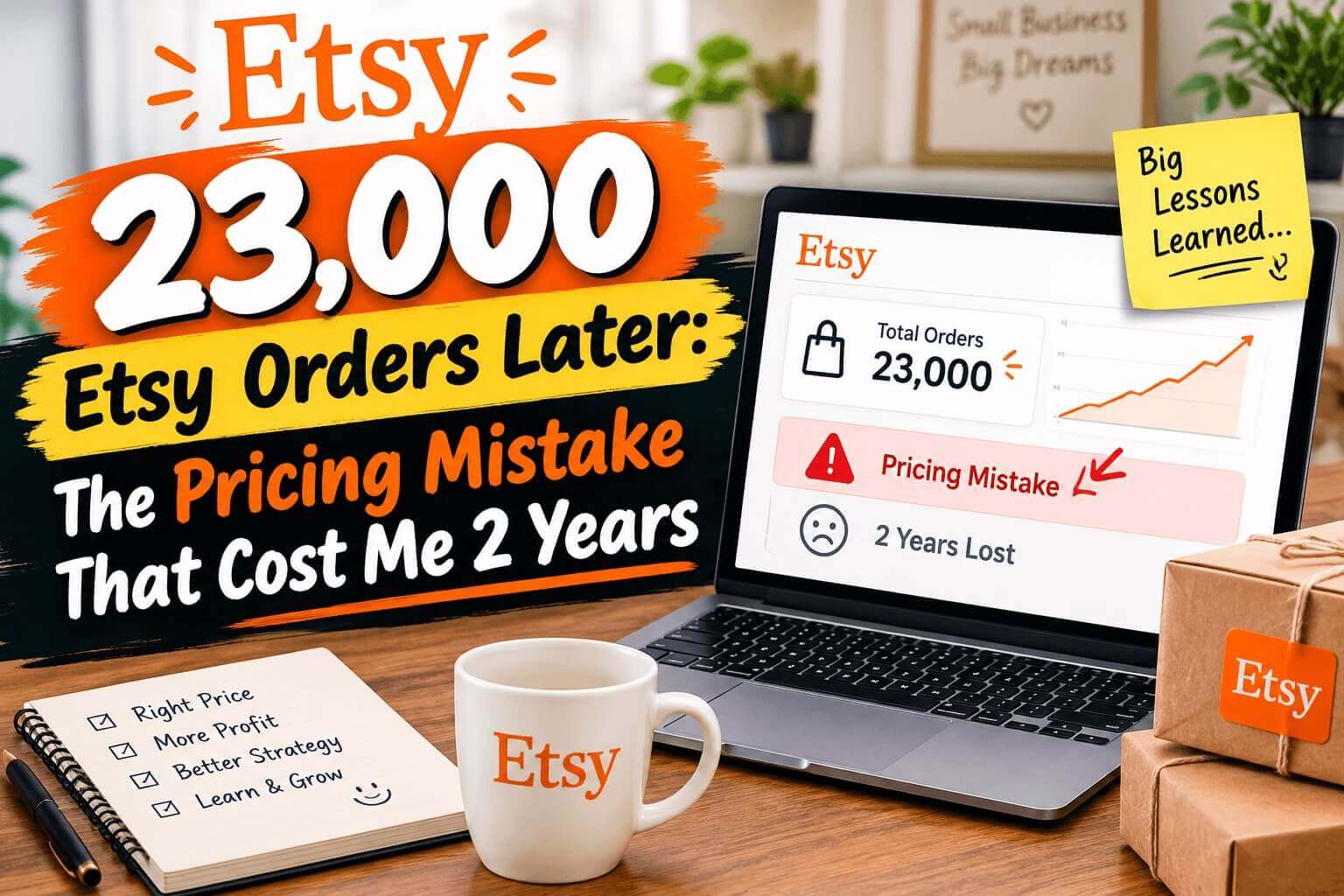
Two numbers from my own businesses, both true this week.
On Etsy, my main listing sells custom embroidery digitizing for $3.28. That listing has helped drive 23,301 sales since I opened the shop in 2022. Right now more than twenty people have it sitting in their cart.
On Fiverr, buyers order the same service from me at $50, sometimes a hundred.
Same work. Same software. Same person, often on the same afternoon. The only real difference is a number I typed into a form in 2022 and then never went back to.
This is the most expensive mistake I have made online, and the strange part is that by every visible metric it looks like a success.
Why the price was $3 in the first place
In 2022 my shop had zero sales, zero reviews, and no reason for anyone to pick it. Etsy is a search engine before it is a marketplace, and a listing with no history has no signal to rank on.
So I did what almost every new seller does. I made the price small enough that ordering felt like nothing. At three dollars, a buyer is not really evaluating me. They are not doing risk assessment. They are clicking.
And it worked, genuinely. Orders came in. Reviews accumulated. The shop climbed. Today the rating sits at 4.9 across 3,574 reviews, and 1,651 people have favourited the shop.
If you had asked me in year one whether the strategy was correct, I would have pointed at the numbers and said obviously yes.
What the price actually bought
Here is what I did not understand at the time.
The three dollars did not buy me customers. It bought me ranking. Etsy’s algorithm rewards listings that convert, and nothing converts like a price low enough to be an impulse. Every cheap sale told Etsy this listing works, so Etsy showed it to more people, who bought it because it was cheap, which told Etsy it worked.
That loop is real and it is powerful and it is also a trap, because the thing being reinforced is not the quality of the work. It is the smallness of the number.
Four years later I have 23,301 sales, and every single one of them is a public record of someone paying roughly three dollars for this service.
Your review history becomes your price
This is the part nobody warns you about.
Raising a price on a new shop is easy. Nobody has any expectations yet. Raising it on a shop with twenty-three thousand completed orders is a different problem entirely, because you are not just asking for more money. You are contradicting your own archive.
A buyer landing on my listing can see, in effect, that tens of thousands of people got this for three dollars. If tomorrow it says fifteen, the obvious question is what changed. Nothing changed. That is exactly the problem.
And my own reviews say it back to me. One of them, from a repeat customer, praises the turnaround, the communication, and in the same breath, “a good price.” She is not wrong. She is describing accurately what I built.
I built a reputation for being cheap, using a service that is not cheap to produce.
The comparison that finally made it obvious
I would probably still be rationalising this if I did not sell the same service on another platform.
There, the same work moves at fifty dollars and up, from buyers who do not blink at it, several of whom have been ordering for years. The quality is identical. The turnaround is identical. The only variable is the number those buyers first encountered.
That is the whole lesson, and it is uncomfortable: price is not a reflection of what your work is worth. It is an instruction to the buyer about how to value it. Set it at three dollars and you are telling people this is a small thing. Set it at fifty and you attract a buyer who was never shopping on price to begin with.
I ran both experiments simultaneously for four years without noticing I was running them.
The other thing 23,000 sales hides
My shop has twelve listings.
Twelve. After four years. The overwhelming majority of those sales funnel through a handful of them, and the flagship is the cheapest one.
High order volume is comforting. It feels like proof that things are working. But volume can conceal a shop that is narrow and underpriced just as easily as it can signal a healthy one. Twenty-three thousand orders at three dollars and two thousand at thirty are the same revenue with wildly different amounts of work behind them, and only one of those leaves you time to build anything else.
For years the volume told me I was fine. The volume was the thing hiding the problem.
What I would do differently
Start at a price you would still accept in three years. Not the price that makes the first sale easy. The first sale is going to be hard either way; at least make it a sale worth having.
If you must open cheap, put an expiry on it. Decide in advance: fifty orders, or three months, then the price moves. Write it down. Otherwise the temporary price quietly becomes permanent, because it is always working well enough to justify leaving alone.
Raise it on new listings, not old ones. This is what I should have done in year two. You cannot easily reprice a listing carrying thousands of cheap orders, but you can launch beside it at a real price and let the two run. If the new one sells, you have your answer without breaking what already works.
Watch what your reviews praise. If buyers keep mentioning the price, that is not a compliment on your craft. It is a report on what your listing is signalling about you.
Ask whether volume is covering something. Twenty-three thousand orders looked like a healthy business right up until I compared the per-order number with what the identical work earns somewhere else.
The listing is still live at $3.28. Twenty people have it in their cart right now.
I have not fixed it yet, and I want to be honest that part of the reason is fear. That listing is four years of ranking, and I do not entirely know what happens to it if I touch the number.
Which, I think, is the real cost of the mistake. Not the money I left on the table over 23,301 orders. The fact that after all of it, I am still a little afraid of my own price.
FAQs
If the low price worked, why call it a mistake?
Because it worked at the wrong job. Three dollars did not win me customers, it won me ranking. Etsy promotes listings that convert, and nothing converts like a price small enough to be an impulse. So the algorithm kept rewarding the cheapness rather than the work. Four years and 23,301 orders later, I have an excellent shop built on the one number I would most like to change.
Can’t you just raise the price now?
Technically yes, and that is what makes it deceptive. The real obstacle is that a listing carrying 23,301 completed orders has trained every visitor on what this service costs. Raising the number does not just ask for more money, it contradicts four years of public record. There is also a practical fear: that listing is my entire ranking history, and I do not know for certain what Etsy does with it if the price moves sharply.
What should a new seller open at instead?
Open at a price you would still accept three years from now. Your first sale is going to be difficult at any price, so it may as well be a sale worth having. If you genuinely need a low entry price to get moving, give it an expiry date before you publish: fifty orders, or ninety days, whichever comes first. Write it somewhere you will see it. Temporary prices become permanent because they keep working just well enough to leave alone.
How do you raise prices without destroying a listing that ranks?
Do not touch the old one. Publish a second listing beside it at the price you actually want, and let both run. The established listing keeps feeding you traffic while the new one tells you whether buyers will pay more. This is what I should have done in year two, and it costs nothing but the listing fee to test.
Isn’t a high order count proof that things are working?
Not on its own, and that is the part that fooled me longest. Twenty-three thousand orders at three dollars and two thousand at thirty produce comparable revenue with entirely different workloads behind them, and only one of those leaves you room to build anything else. Volume is a comfortable number to look at. It is also very good at hiding a shop that is underpriced and narrower than it should be. Mine has twelve listings after four years.