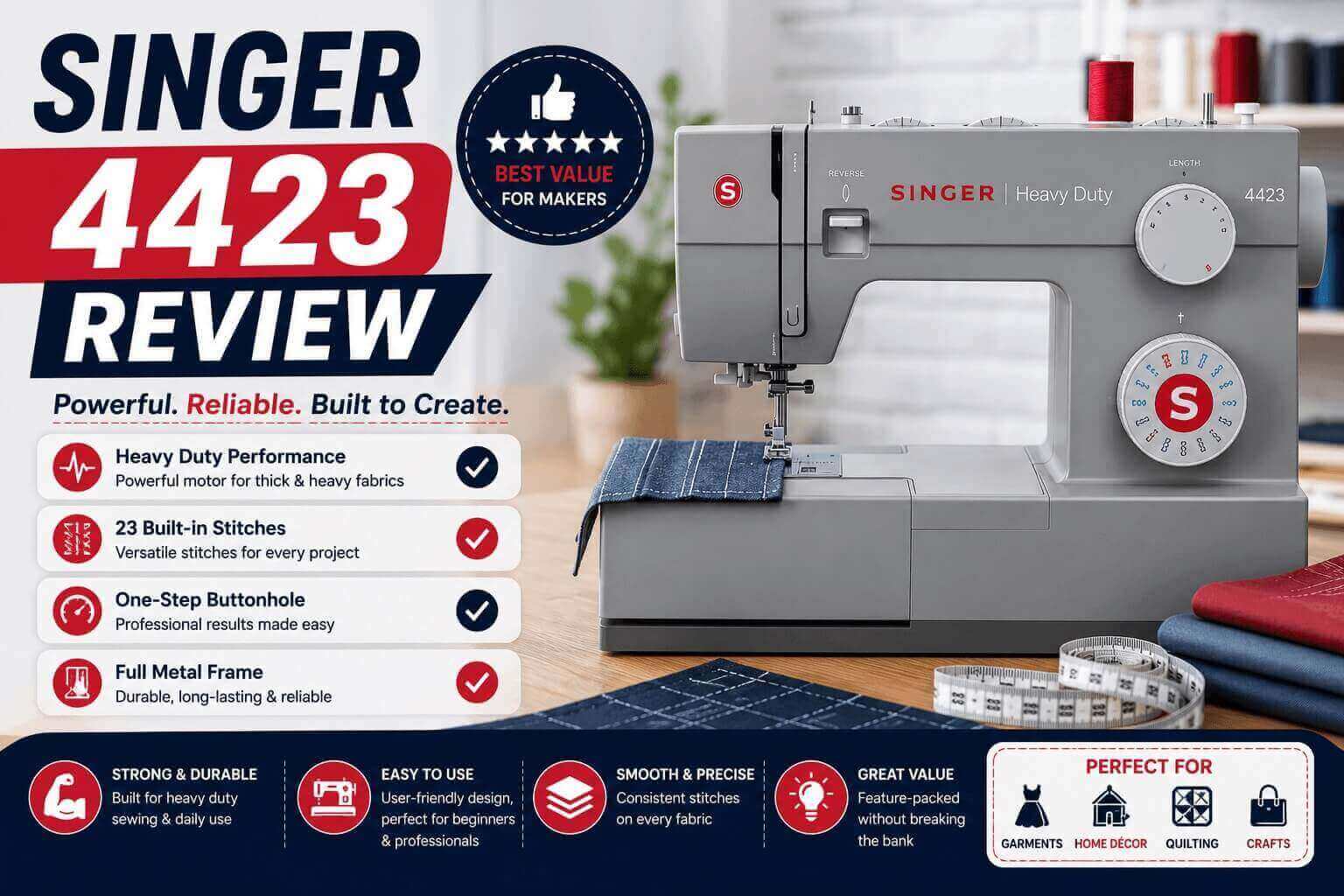
This Singer 4423 review is a specification and comparison guide rather than a hands on test. We have not stitched on this machine, so nothing here pretends otherwise. Everything below comes from Singer’s own published specifications and from documented comparisons against the 4411 and 4432, which genuinely helps if you are trying to work out which of the three to buy.
Be aware. Most Singer 4423 review articles online use the first person and describe personal use. Some of those are real. Many are not, because writing a review of a machine you have never touched is easy and common. We are telling you which kind this is, so you can weigh it accordingly.
Quick answer
The Singer 4423 is a mechanical heavy duty sewing machine with 23 built in stitches, an internal metal frame, a motor rated 60 percent stronger than standard and a top speed of 1,100 stitches per minute. It sews. What it does not do is embroider. Within its own family it sits between the cheaper 4411 and the 4432.
Singer 4423 Review: The Short Version
Any honest Singer 4423 review starts with one fact: it is a mechanical machine, which means dials rather than a screen. That is the appeal. There is no computer board to fail, and the parts that matter are metal.
Singer positions the whole Heavy Duty line, the 4411, 4423, 4432 and 4452, at people who want to sew denim, canvas and multiple layers without a machine that stalls. The 4423 sits second from the bottom, and most comparisons call it the value pick of the four.
What it is not is an industrial machine. Think domestic machine with a strong motor, which matters for expectations. Singer never designed it to run eight hours a day in a production shop.
The Specs That Matter
The numbers below come straight from Singer’s published specifications, so this part of the Singer 4423 review contains no estimates.
| Feature | Detail |
|---|---|
| Built in stitches | 23, made up of 6 basic, 4 stretch, 12 decorative and 1 buttonhole |
| Maximum speed | 1,100 stitches per minute |
| Motor | Rated 60 percent stronger than a standard domestic motor |
| Frame | Metal interior frame, stainless steel bed plate |
| Buttonhole | One step automatic |
| Needle threader | Built in automatic |
| Presser feet | 4 included |
| Other | Adjustable presser foot pressure, free arm, reverse lever, drop feed, three needle positions |
Two of those deserve a second look. Adjustable presser foot pressure is what lets the same machine feed sheer fabric and canvas without mangling either, and plenty of machines at this price do not offer it. Drop feed matters if you ever want free motion work, because the fabric only moves where you push it.
The full specification list sits on Singer’s own product page if you want to check anything before buying.
What The 23 Stitches Cover
Six basic stitches handle straight, zigzag and the everyday work. Four stretch stitches matter more than the number suggests, because sewing knits with a plain straight stitch pops the seam the first time someone stretches it.
Twelve decorative stitches round it out, and one automatic buttonhole finishes the list. For garments, repairs, home decor and bags, that covers nearly everything.
Selection is by dial rather than screen. Slower than tapping an icon, though there is nothing to crash and nothing to update.
Singer 4423 vs 4411 vs 4432
Buyers confuse these three constantly. The honest summary: they share the same body and motor, and only the stitch count and a couple of conveniences differ.
| Model | Stitches | Key difference |
|---|---|---|
| 4411 | 11 | Four step manual buttonhole, no needle threader |
| 4423 | 23 | One step buttonhole, automatic needle threader |
| 4432 | 32 | More stretch and decorative stitches, 110 applications |
Recent published pricing puts roughly sixteen dollars between the 4411 and the 4423, and another twenty five or so up to the 4432. Prices move, so treat that as a rough gap rather than a quote.
At that spread, the 4411 is hard to recommend. Sixteen dollars buys twelve more stitches, a one step buttonhole and a needle threader, and the threader alone saves time every session. Going up to the 4432 only makes sense if decorative stitches genuinely interest you.
Will It Sew Leather And Denim?
Denim, yes, and that is much of the point of the range. Multiple layers, hems, seams. Fit a heavier needle, typically a 90/14 or 100/16 with a sharp point, since a universal needle in denim is how you snap needles.
Leather needs a more careful answer. Lightweight leather, faux leather and garment weight hide are within reach with a leather needle and a suitable foot such as a walking or roller foot. Thick vegetable tanned leather, several layers of it, or holster weight work is not. That is industrial territory, and no domestic machine changes that.
Anyone telling you a $200 domestic machine sews tooling leather effortlessly is describing something other than what the specification supports.
Where The Singer 4423 Falls Short
No Singer 4423 review is useful without the trade offs, and knowing them beforehand beats discovering them after.
- Speed control is manual. There is no slider limiting top speed. At 1,100 stitches per minute the pedal is sensitive, which takes practice.
- No walking foot included. Fine for most work. Quilting through layers and sewing leather both benefit from one, so budget for it.
- Mechanical means no memory. No stitch sequences, no saved settings, no needle up or down button. Dials only.
- Noise. An all metal machine at high speed is not quiet. That is physics, not a defect.
- The steel bed plate shows fingerprints. Cosmetic, but people mention it constantly.
Does The Singer 4423 Embroider?
No, and this catches people out often enough to state plainly. The 4423 is a sewing machine. There is no hoop, no design memory, no USB port and no way to load a stitch file.
The decorative stitches produce repeating patterns along a line, which is a different thing from embroidering a logo. If you want a name or a logo stitched onto a garment, you need an embroidery machine, and those read design files such as PES or DST.
If you already own an embroidery machine and need a logo turned into a file it can read, that is a separate job called digitizing, and our guide on how to digitize a logo for embroidery explains what it involves. We also offer professional embroidery digitizing services if you would rather hand it over.
Who The Singer 4423 Suits
Pull all of this Singer 4423 review together and one buyer emerges. Someone who sews real garments and repairs, works with denim or canvas often enough that a weak motor is annoying, and prefers dials to menus. Beginners do well with it because there is little to misunderstand.
Look elsewhere if you want computerised convenience, a wide extension table included, or embroidery. And if you are running a business stitching eight hours a day, buy an industrial machine instead. This one will do it, but not for as long as you would like.
Frequently Asked Questions
Is this Singer 4423 review based on hands on testing?
No. It draws on Singer’s published specifications and on documented comparisons across the Heavy Duty range. We say so because plenty of review articles imply personal use without it. For hands on impressions, look for reviews with the writer’s own photographs and specific project details.
Is the Singer Heavy Duty 4423 a good sewing machine?
For its category, yes. A metal internal frame, a motor rated 60 percent stronger than standard and 1,100 stitches per minute is a strong specification at this price. It is mechanical, so it trades convenience features for fewer things that can break.
Which is better, the 4423 or the 4432?
They share the same frame, motor and speed. The 4432 adds nine stitches, more stretch and decorative options, and a wider set of stitch applications. If decorative stitching interests you, take the 4432. If you mainly sew garments and repairs, the 4423 covers it.
Is the 4411 or the 4423 better?
The 4423, for most people. Same frame and motor, but you gain twelve stitches, a one step automatic buttonhole and an automatic needle threader for a small price difference. Only pick the 4411 if you strictly need straight and zigzag stitching at the lowest cost.
Will a Singer 4423 sew leather?
Lightweight leather and faux leather, yes, with a leather needle and a suitable foot. Thick vegetable tanned or multiple heavy layers, no. That needs an industrial machine, whatever any product listing suggests.
Does the Singer 4423 need oiling?
Singer pre lubricates it at the factory, so it does not need oiling straight away. Normal care still applies: keep lint out of the bobbin area, change needles regularly and cover it when not in use. Check the manual for the maintenance schedule.
About Fast Digitizer. We are a Chicago based studio that digitizes logos and artwork into embroidery machine files. We do not sell sewing machines and we earn nothing from this page. See our range of custom embroidery digitizing if you have an embroidery machine and need files for it.