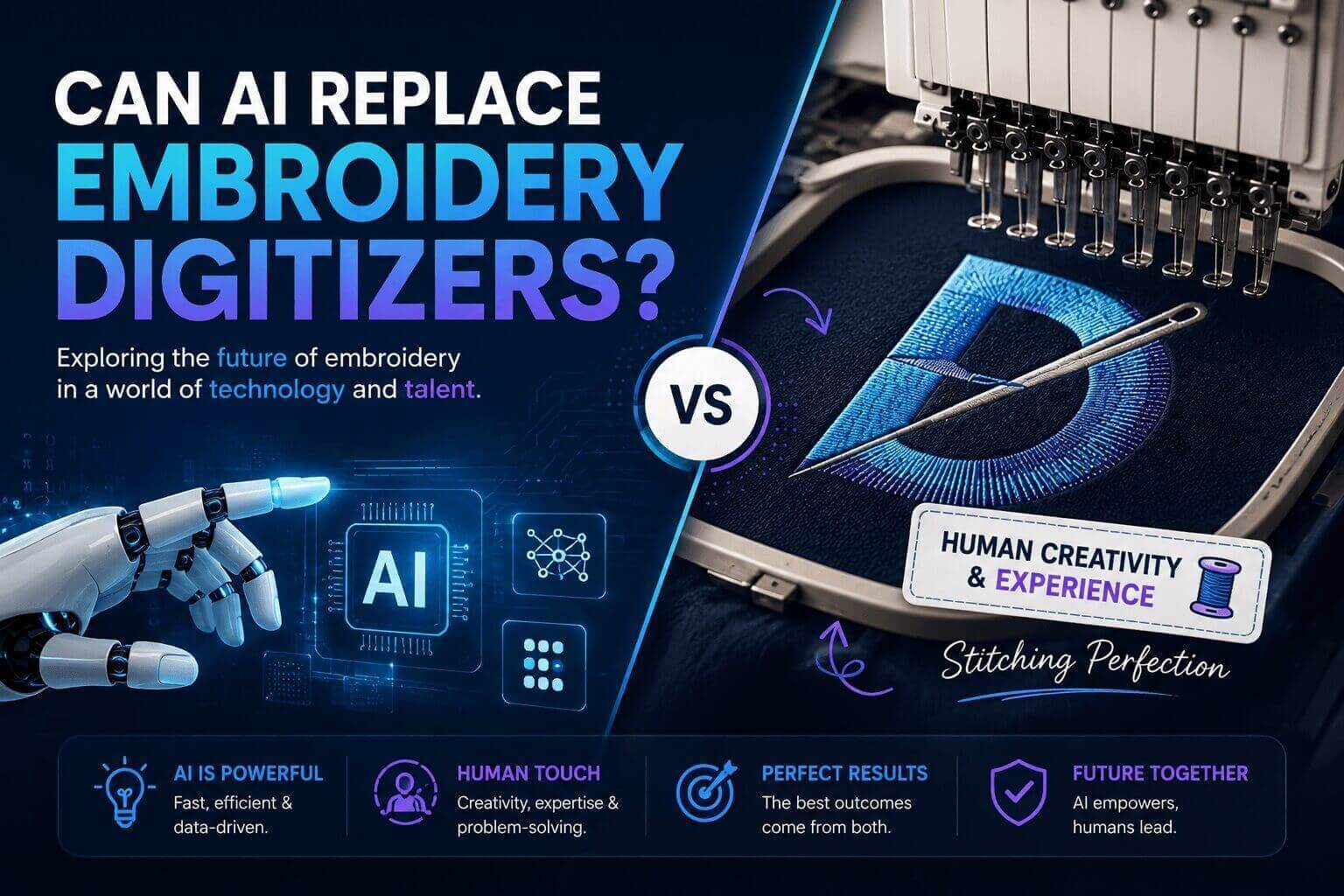
Can AI replace embroidery digitizers? Partly, and it already has at the simple end. Auto digitizing handles a two colour monogram in under a minute, which used to be paid work. What it still cannot do is make the fabric specific decisions that keep a design from puckering, gapping or breaking thread on a production run. This guide covers exactly where that line sits as of late 2026.
Worth knowing. Fast Digitizer is a digitizing studio, so we have an obvious interest in this answer. We have tried to be straight about what AI genuinely does well rather than talk it down. Where it beats us, we say so.
Quick answer
Can AI replace embroidery digitizers on production work? Not yet. Auto digitizing tools now produce clean results on simple shapes and lettering, and they are genuinely faster and cheaper for that. They still guess wrong on underlay, fabric density and stitch path, which is where files fail on the machine rather than on screen.
Can AI Replace Embroidery Digitizers? The Short Answer
Split the work into two piles and the question of whether AI can replace embroidery digitizers stops being confusing.
Simple pile: a two colour monogram, a block text name, a basic shape on a stable cotton tee. Auto digitizing does this well now, in thirty seconds to five minutes, often included in a software subscription. Paying someone for that job is getting harder to justify.
Complex pile: a logo with small lettering, a cap with curved seams, applique, 3D puff, anything on stretch fabric or fleece. Here the file has to account for how the fabric moves under the needle, and that is where automated output still needs a person.
What AI Already Does Well
Can AI replace embroidery digitizers at anything today? Yes, at plenty. Pretending otherwise just makes you look uninformed to anyone who has tried the tools.
Modern auto digitizing reads a PNG, JPEG or vector, separates the colours, maps the stitch regions and writes a machine file. Hatch 4’s 2026 update produces notably clean results on simple shapes and lettering. It is fast, it is cheap, and for a hobbyist running one machine it is often the correct choice.
AI assistance inside professional software is also genuinely useful. Automatic colour separation, suggested stitch types, and faster conversion of clean vector art all save real time. Most working digitizers already use some of it.
Where Auto Digitizing Still Breaks Down
Three failures show up again and again, and they are the reason the question of whether software can replace people is still open. All three appear on fabric rather than on screen. That gap is the whole problem, because the preview looks fine right up until the machine runs.
Underlay defaults. Automated files use generic underlay. Experienced digitizers replace it with a layered approach, contour underlay under satin columns and edge walk plus zigzag under large fills. One production digitizer reckons this single change fixes roughly sixty percent of the problems in auto generated files.
Fabric density. Stable twill might need around 0.4 to 0.5 mm on fills. Stretch pique needs closer to 0.6 to 0.8 mm. That has to change per object, not globally across the design, and software cannot know your fabric.
Stitch path. Automated pathing is logical rather than optimal. It jumps across open fabric because it is optimising colour order, where a person reroutes those travels underneath areas already stitched. Fewer visible trims, cleaner back.
Three Decisions AI Cannot Make For Embroidery Digitizers
Ask can AI replace embroidery digitizers on judgement, rather than on speed, and the answer gets clearer. Three calls need information the software never receives.
- What to remove. A logo at four inches cannot carry every element it has on a business card. Deciding what to drop is a design decision, not a conversion problem.
- What the garment will do. Fleece sinks stitches. Knit stretches. A structured cap fights the needle from the centre out. The file changes for each, and nobody tells the software which one you are using.
- What the client actually meant. When artwork is ambiguous, a digitizer asks. Software guesses, confidently, and you find out during the run.
Our guide on how to digitize a logo for embroidery walks through those decisions in order if you want to see what actually gets decided.
What AI Actually Means Inside Embroidery Software
The word gets stretched, so it helps to separate three different things sold under the same label.
Auto digitizing is image analysis and edge detection. It has existed for years and has improved steadily rather than suddenly. Generative AI, the kind that writes text or makes pictures, plays almost no part in producing stitch files.
Then there are AI assistants bolted onto software. Hatch 4 ships an assistant called Answers, which you can see on the official Hatch product page. Useful, though it answers questions about the software rather than digitizing your file.
Finally there is marketing. Plenty of tools now carry an AI badge for features that predate the current wave entirely. Ask what the tool actually does before paying for the label.
Can AI Replace Embroidery Digitizers For Simple Work?
Yes, and that is already happening. Basic monograms, plain text names, simple two colour shapes on stable fabric. If that is all you need, buy the software rather than the service.
Test it honestly before deciding, though. Artwork quality changes the result more than the tool does, and our note on digitizing images for embroidery covers what makes a file easy to convert. Run the auto file on the actual garment, not a scrap of quilting cotton. Then check three things: does the edge sit clean where two colours meet, does the fabric lie flat around dense areas, and how many trims are showing on the back.
If all three pass, you have saved money and you should keep doing it. If they do not, you have learned exactly what you are paying a digitizer to fix.
What This Means If You Buy Digitizing
Can AI replace embroidery digitizers cheaply enough to change your costs? It already has. The floor price has dropped and it will keep dropping, which is a real benefit to you.
What changes is what you should ask for. Stop paying a person for work software does well. Start paying for the jobs where files fail: caps, small lettering, specialty techniques, unusual fabrics and anything running across hundreds of garments where a bad file costs you on every piece.
Ask any provider one direct question: does a person build this file, or does software? Some now sell auto generated output at manual prices, which is the actual thing to watch for. Our comparison of digitizing providers covers what else to check.
Can AI Replace Embroidery Digitizers As A Career?
Not soon. Still, the shape of the job is changing, and pretending otherwise helps nobody.
The simple work is going. Anyone whose business was cheap, fast monograms is competing with a subscription now. Meanwhile demand for specialty work has grown, because applique, 3D puff and chain stitch all need construction knowledge that automation has not touched.
The practical move is to stop selling conversion and start selling judgement. Correcting automated files, handling difficult fabrics and specialty techniques are all work that pays better than what it replaced. Our custom embroidery digitizing page covers the techniques worth learning.
Tried the auto file and it failed?
Send us the artwork and the garment. We will tell you honestly whether it needs a rebuild or just a fix.
Frequently Asked Questions
Can AI replace embroidery digitizers completely?
Not for production work as things stand in late 2026. Ask whether AI can replace embroidery digitizers on a monogram and the answer is yes. It handles simple shapes and lettering well, and it genuinely replaces paid work at that level. Complex logos, caps, specialty techniques and difficult fabrics still need a person, mainly because underlay, density and stitch path depend on information the software never gets.
Can I use AI to digitize embroidery designs?
Yes, using auto digitizing inside software such as Hatch, Wilcom, Chroma or Ink/Stitch. Expect a usable starting point rather than a finished file. Budget time for correcting underlay, adjusting density to your fabric and rerouting jump stitches before production.
Can ChatGPT digitize images for embroidery?
No. A chat assistant can tidy artwork or explain the process, but it cannot output a machine file such as DST or PES. Digitizing means building stitch objects with density, underlay, pull compensation and a sewing order, which requires embroidery software rather than a language model.
Is there a free AI digitizer for embroidery?
Ink/Stitch is free and open source, runs inside Inkscape and exports real machine files including DST and PES. Several paid packages offer time limited trials. Free auto digitizing generally needs more manual correction than paid tools, so the cost moves from money to hours.
Do professional digitizers use AI?
Many do, for colour separation, first pass conversion of clean vector art and routine lettering. Very few hand over final production files without editing them. Treating automation as a starting point rather than a finished product is the normal professional workflow now.
What are the limitations of AI in embroidery digitizing?
Generic underlay, fabric blind density settings, unoptimised stitch paths and no ability to simplify artwork for the finished size. Add to that no way to ask a question when artwork is ambiguous. Every one of these shows on fabric rather than on screen, which is why a preview looks fine and the run does not.
About Fast Digitizer. We are a Chicago based studio digitizing logos, caps, applique, puff and chenille designs for embroiderers across the United States. Our team builds every file by hand and delivers it with a production worksheet. See our full range of professional embroidery digitizing services or send your artwork for a free quote.