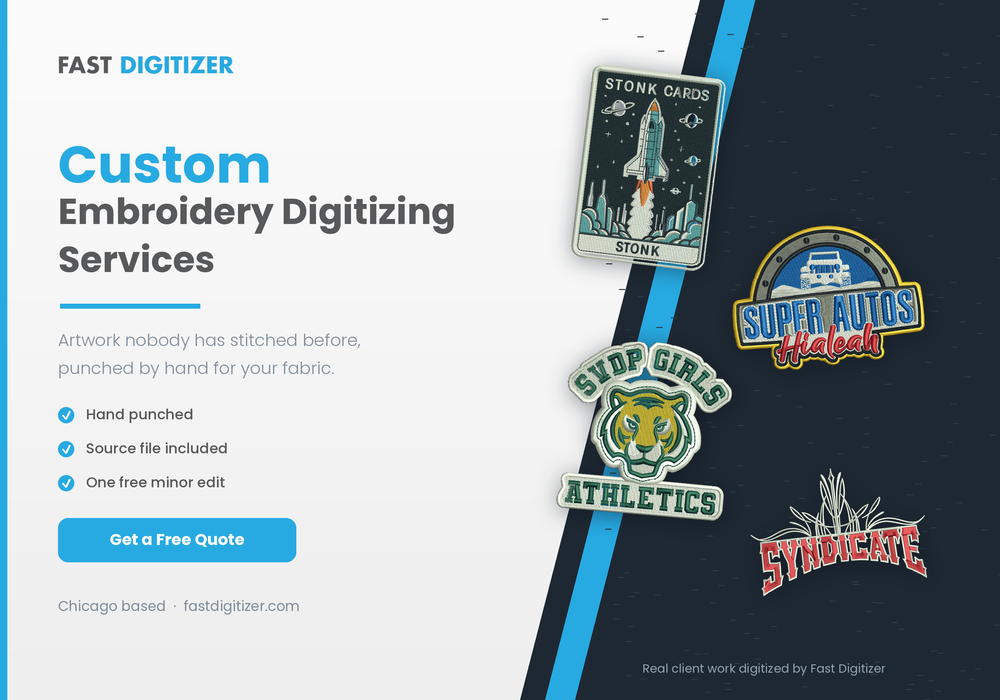
Custom embroidery digitizing services turn artwork nobody has stitched before into a file your machine can run cleanly. That word custom carries real weight here, because a stock design has already been tested on fabric while yours has not. Everything that decides whether your logo sews beautifully or fails on the tenth garment gets decided during that first punch.
What Makes Custom Embroidery Digitizing Services Different
With custom embroidery digitizing services, the difference is not the price or the turnaround. It is whether anyone has stitched that artwork before.
By contrast, a stock design has already been sewn out, corrected and reissued. Somebody found the problems and fixed them. Your logo has none of that history, so the digitizer makes every judgement fresh: which shapes become satin, which become fill, how dense the coverage runs on your specific fabric, and what detail has to disappear because thread cannot hold it.
Consequently, custom embroidery digitizing services charge more than a two dollar download. You are paying for decisions, not for a file transfer.
How Much Do Custom Embroidery Digitizing Services Cost?
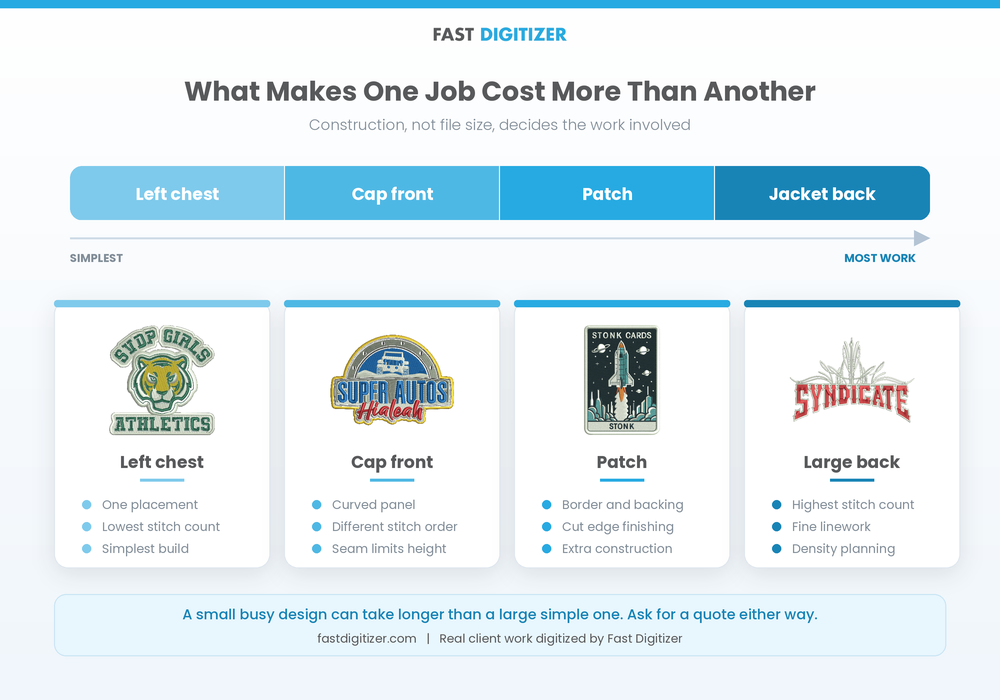
Generally, most standard logos run between $10 and $40 in the United States. Left chest designs sit at the lower end because they carry the least construction. Jacket backs, appliqué, 3D puff, patches and photo work cost more, since each adds layers the digitizer has to plan around.
Meanwhile, two pricing models exist and they behave very differently. Per design pricing gives one number regardless of stitch count. Per thousand stitches scales with size, which suits large simple designs but punishes small dense ones. Neither is wrong, although you should know which one you agreed to before the invoice lands.
Treat very low prices as information rather than a bargain. Below roughly $5, human digitizing stops being economically possible, so those quotes almost always come from automated conversion with nobody checking the output.
Can AI Replace Custom Embroidery Digitizing Services?
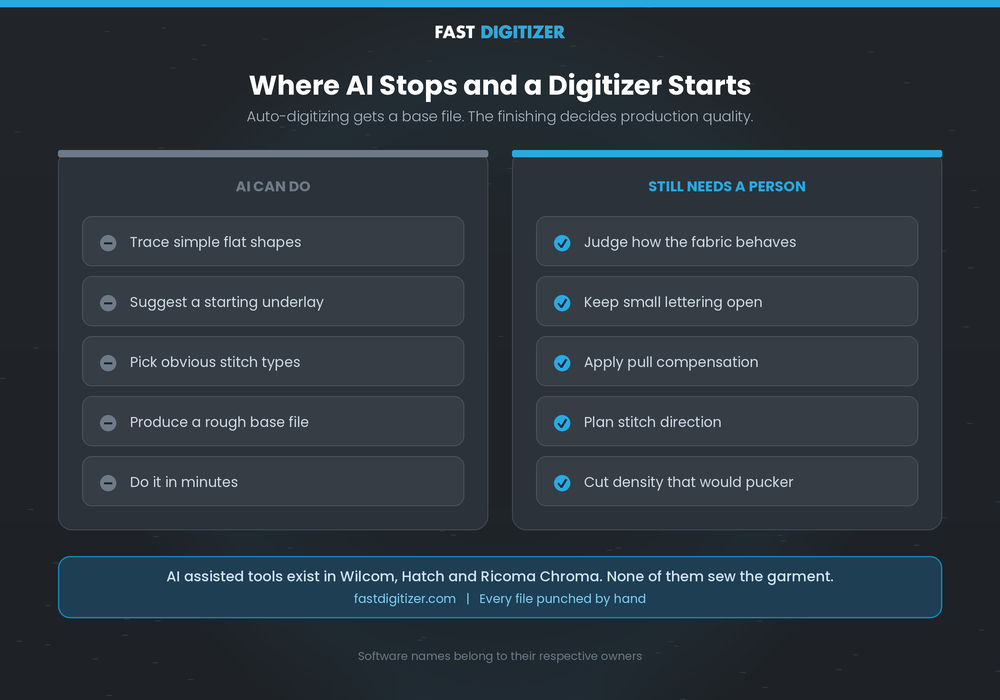
Partly, and the honest answer sits between the two extremes you usually hear. AI assisted auto-digitizing genuinely works for simple flat artwork, and it has improved considerably. It cannot handle fabric behaviour, small lettering or complex layering, so commercial work still needs a person.
In practice, several established programs now include AI assisted features. Wilcom EmbroideryStudio offers auto-digitizing with automatic underlay suggestions and stitch type selection. Hatch, made by Wilcom for smaller shops, includes an auto-digitizer that converts a JPG or PNG into a base file. Ricoma Chroma targets beginners with similar automation.
Above all, what these tools do well is speed. Upload artwork, and within minutes you have something roughly usable as a starting point rather than a blank canvas.
Where AI still fails
However, the gaps are consistent across every tool, and they are the same gaps that decide production quality.
- Fabric behaviour. Firstly, software cannot know that your polo is a stretchy performance knit rather than stable twill, so density and underlay come out generic.
- Small lettering. Similarly, text below roughly a quarter inch needs specific stitch choices. Auto tools close it into solid blobs.
- Thin lines and fine detail. Anything narrower than about 1 mm confuses automatic tracing rather than getting simplified deliberately.
- Push and pull compensation. Fabric moves as thread tightens. Without compensation, circles stitch out oval.
- Stitch direction and layering. Thread reflects light along its length, and direction is an artistic decision rather than a calculation.
- Excess density. Finally, auto generated files frequently over-stitch, which causes thread breaks and puckering on real garments.
Therefore a reasonable way to think about it is that AI gets you a rough base file, and a digitizer turns that into something production ready. If you want to see what that finishing actually involves, our walkthrough on how to digitize a logo for embroidery breaks it into six steps. The finishing work is where the quality lives, and that has not changed.
How Do I Digitize My Own Embroidery Designs?
You can, and the software costs far less than most people expect. Ink/Stitch is free and open source, running as an extension inside Inkscape. Version 3.3.0 arrived on 31 July 2026. SewArt sits around $75 with a thirty day demo, while Hatch and Brother PE-Design both offer trials.
Instead, the real cost is learning time. Expect several weeks of regular practice before your files stitch cleanly, and several months before you handle caps, knits and small lettering consistently.
First, start with a two colour design containing bold shapes and no text, stitched on stable woven fabric. Master satin columns and simple fills first. Then add lettering, since text exposes weak digitizing faster than anything else. Our guide on digitizing images for embroidery explains how artwork complexity changes the work involved.
Finally, run the arithmetic honestly before committing. At two designs a month, outsourcing costs roughly $240 a year and none of your time. At twenty designs a month, learning it yourself starts making obvious sense.
Where to Find Custom Embroidery Digitizing Services
Three routes exist for custom embroidery digitizing services, and the right one depends on what the file is worth to you.
Specialist digitizing services handle this as their only business. Turnaround is usually same day to a few days, and files come back in your machine format. This suits logos, client work and anything going into production.
Meanwhile, marketplace freelancers cost less and vary enormously. Quality ranges from excellent to auto-traced, so ask for sewout photos before committing to volume.
Finally, your embroidery machine dealer sometimes offers digitizing, and they know local machines well. Prices tend to sit higher.
Whichever route you pick, judge them on the same four things: whether files are punched by hand, whether the source file comes with the order, whether they ask about fabric before quoting, and whether they can show photographs of stitched garments rather than screen renders. Those are the same standards behind our own embroidery digitizing services.
What to Send Custom Embroidery Digitizing Services
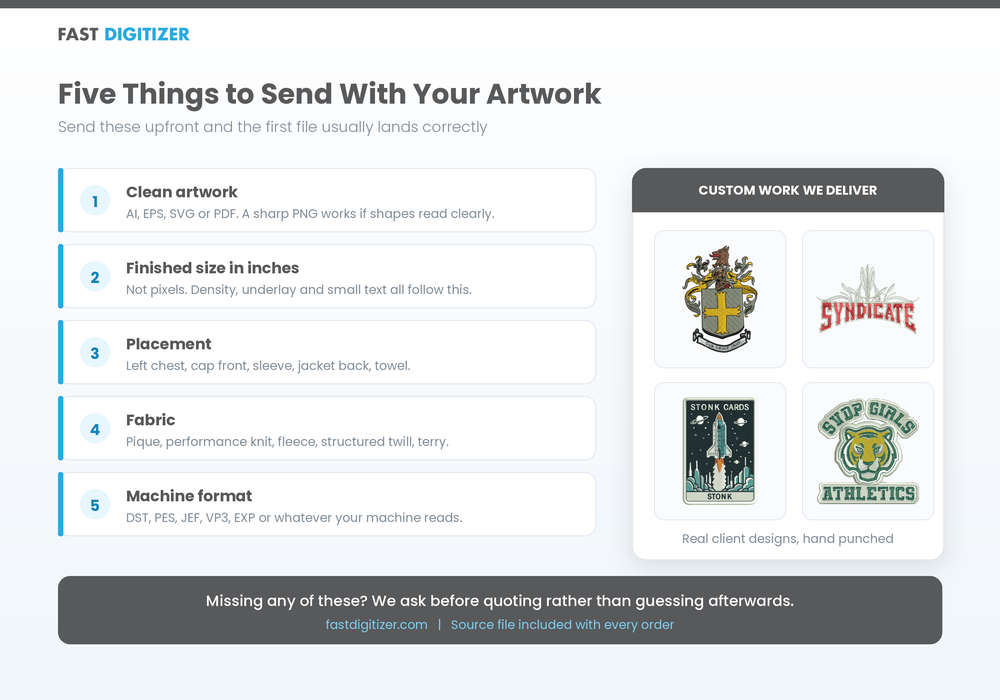
Fortunately, five details prevent nearly every revision request, and sending them upfront usually means the first file lands correctly.
The cleanest artwork you have. Vector formats such as AI, EPS, SVG or PDF remove compression problems entirely. A sharp PNG works when the shapes read clearly. For more on preparing artwork, see our guide on how to convert a JPG to an embroidery file.
Finished size in inches. Not pixels, and certainly not roughly the size of a logo. Density, underlay and whether small text survives all depend on this number.
Placement. Left chest, cap front, sleeve, jacket back and towel all behave differently under the needle.
Fabric. Cotton pique, performance knit, fleece, structured twill and terry each need different settings.
Machine format. DST is the widest accepted commercial format, whereas PES suits Brother and Babylock, JEF suits Janome and VP3 suits Husqvarna Viking.
Red Flags When Comparing Digitizing Services
Similarly, some warning signs appear before you place an order. Any one of these justifies asking harder questions, and our comparison of embroidery digitizing companies goes through the full checklist.
- An instant quote with no questions. Because nobody asks about fabric, size or placement, nobody is planning for them.
- The source file treated as an upsell. Without it, any future resize means digitizing from scratch and paying twice.
- A portfolio of screen renders only. Puckering and closed lettering appear on fabric, never on a preview.
- Prices far below the market. Typically a two dollar logo means automated conversion with no human review.
- Rigid turnaround promises. A supplier guaranteeing every file in a fixed number of hours regardless of complexity is either padding the price or rushing the work.
FAQs About Custom Embroidery Digitizing Services
How much does it cost to digitize embroidery?
Typically, most standard logos cost between $10 and $40 in the United States, with left chest designs at the lower end. Jacket backs, appliqué, patches and photo work cost more. Some providers price per thousand stitches instead of per design, so confirm which model applies before ordering.
How do I digitize my own embroidery designs?
First, install digitizing software, then import your artwork, reduce it to a workable number of colours, assign satin, fill and running stitches to each shape, set underlay for your fabric, then export in your machine format. Ink/Stitch is free, while SewArt, Hatch and Brother PE-Design all offer paid options with trials.
Where can I get a picture digitized for embroidery?
Specialist digitizing services, marketplace freelancers, and some machine dealers all offer this service. Judge on whether files are punched by hand, whether the source file is included, and whether they ask about fabric before quoting rather than on advertised turnaround alone.
Can AI do embroidery digitizing?
Partly. AI assisted auto-digitizing in software such as Wilcom, Hatch and Ricoma Chroma produces usable base files from simple flat artwork quickly. However, it cannot judge fabric behaviour, handle small lettering, apply pull compensation correctly or plan stitch direction, so production work still needs a human digitizer to finish it.
What is the difference between custom and stock embroidery designs?
Essentially, stock designs have already been stitched, corrected and reissued, so the problems are known and fixed. Custom work has no such history, which means every decision about stitch type, density and detail gets made fresh for your specific artwork and fabric.
How long does custom digitizing take?
Typically simple left chest logos are ready the same working day, while detailed illustrations, appliqué and photo work take longer. Complexity drives the timeline far more than physical size, so a small busy design can take longer than a large simple one.
Do I own the digitized file?
You should. Once you pay for a design, both the stitch file and the source file belong to you outright, and you should be free to use them on unlimited garments or take them to another supplier. Confirm this in writing before your first order.
Choosing Custom Embroidery Digitizing Services Well
Comparing custom embroidery digitizing services on price alone is the most expensive habit in this industry, because a bad file costs more in ruined garments than the difference between a $9 quote and a $40 one. Send complete details, order one paid test logo, stitch it on the fabric you actually use, and let the sewout decide.