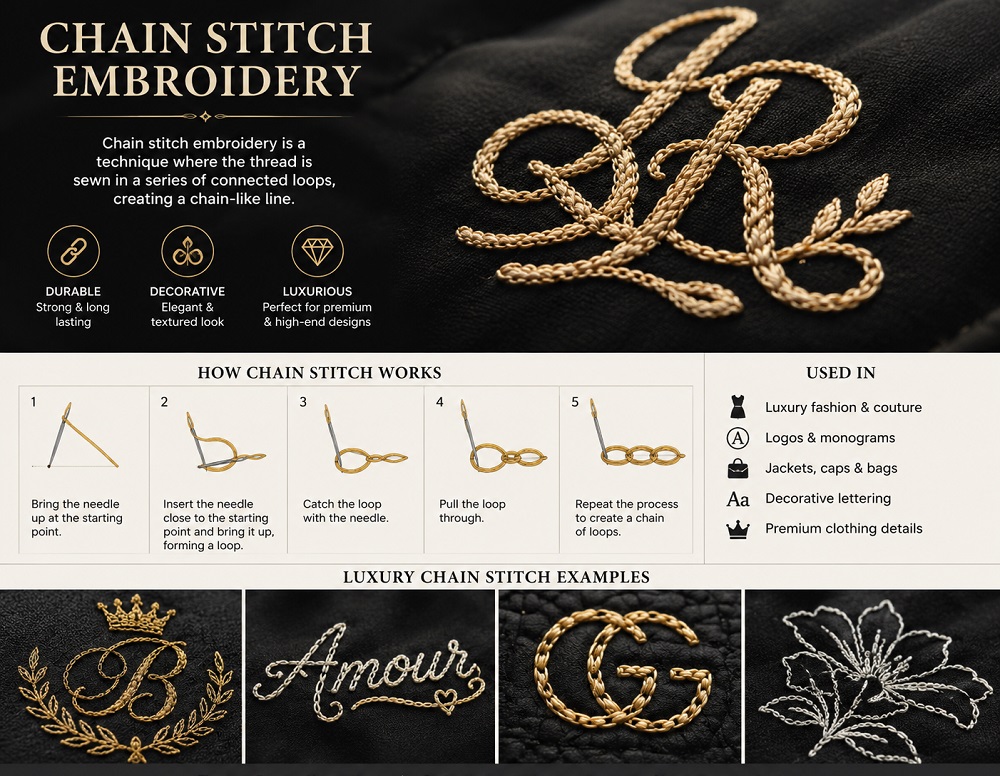
What is chain stitch embroidery? You loop one continuous thread through itself over and over, so each loop locks the one before it. The result is a raised, rope like line rather than a filled shape. Chain stitch embroidery draws with thread instead of colouring it in, which is why it suits script, monograms and vintage logos so well.
Quick answer
Chain stitch embroidery builds a line from a series of interlocked thread loops. A hooked needle catches the previous loop and pulls a new one through it. Because the whole line comes from one thread, it flows like handwriting and sits raised above the fabric.
What Is Chain Stitch Embroidery?
Chain stitch is one of the oldest decorative stitches still in daily commercial use. Surviving Chinese examples worked in silk thread date to the Warring States period, roughly the fifth to third century BC, and archaeologists have found even earlier evidence in Chinese royal tombs. You can read the archaeological detail on the Wikipedia entry for chain stitch.
The mechanism is simple. You hold a loop of thread against the fabric, and the next stitch passes through that loop before anchoring it. Repeat that and you get a chain. Because the needle never has to pass through more than one layer, hand workers can add chain stitch near finished seams without disturbing the construction.
Machines caught up in the 1860s. The French engineer Antoine Bonnaz built the first successful chain stitch embroidery machine in 1865, and Ercole Cornely later acquired the patent and refined it in Paris. Embroiderers soon called them Cornely machines, and the same hook and looper principle still drives chain stitch heads today.
What Makes It Different From Other Stitches
Standard embroidery lays many separate stitches into a shape. Chain stitch builds one unbroken line instead. That single difference changes the texture, the movement and the way a design has to be planned.
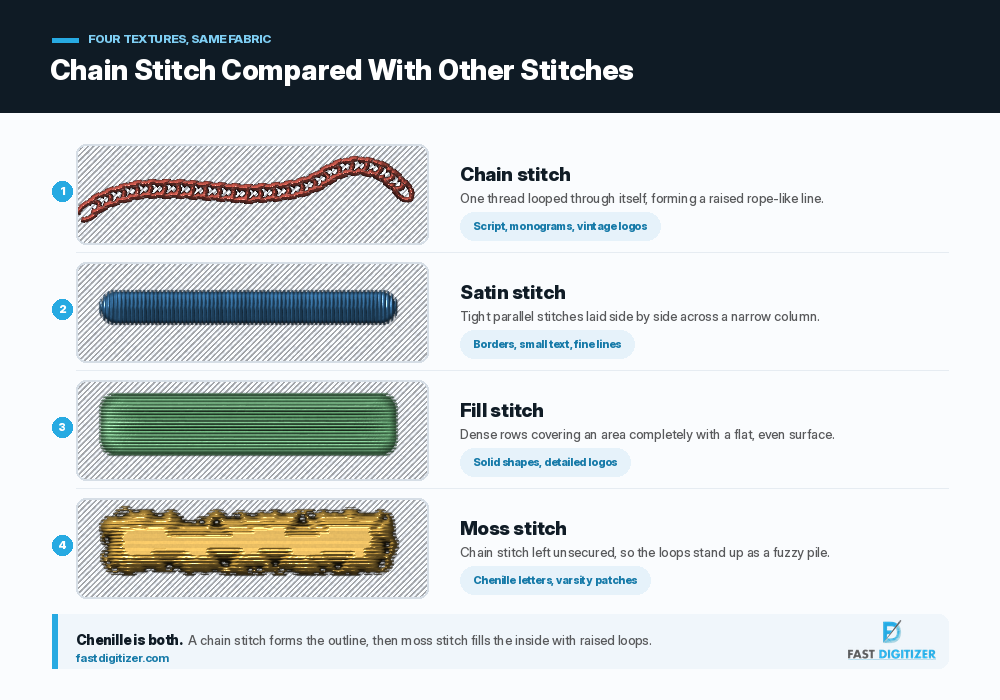
Three qualities set it apart. First, the looped structure sits proud of the fabric, so you feel it as much as you see it. Second, the line follows curves naturally, the way a pen follows a signature. Third, coverage comes from movement rather than density, which keeps the stitch count low even on large lettering.
There is a fourth quality worth knowing about, and it is a trade off. Because everything hangs on one thread, a cut loop can run along the line like a pulled thread in a knit sweater. Secured start and end points prevent that in practice, though it remains a real difference from a locked stitch.
How To Do Chain Stitch Step By Step
Hand chain stitch embroidery takes four moves, and the fourth one repeats forever. Once the rhythm clicks, the line grows quickly. Work on a hoop so the fabric stays under even tension.
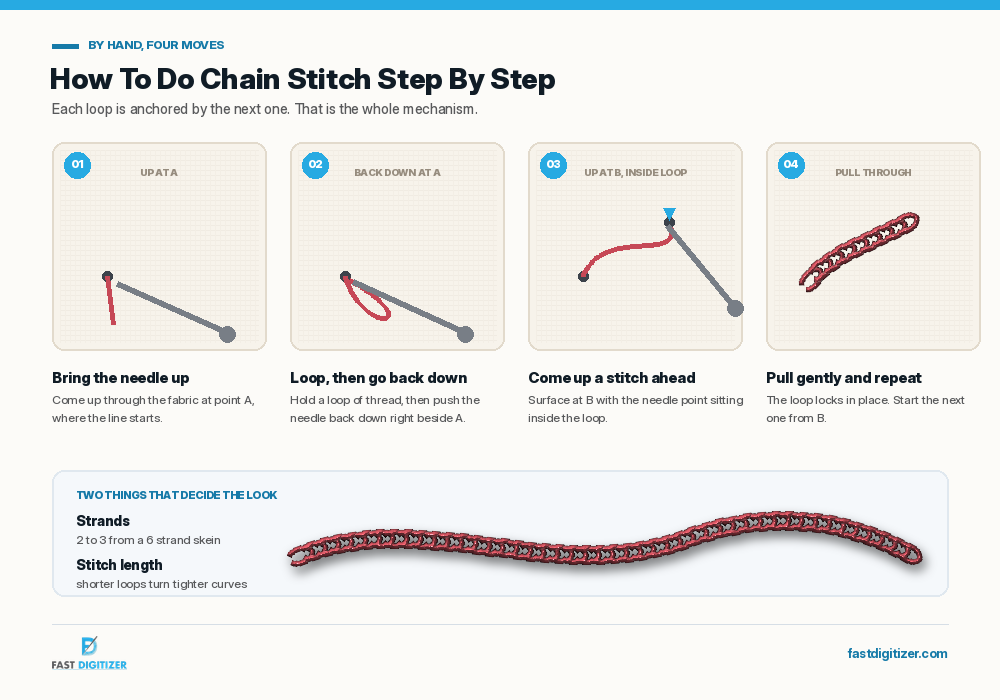
- Come up at A. Bring the needle up through the fabric where your line begins, and pull the thread all the way through.
- Loop and go back down. Hold a loop of thread against the fabric with your thumb, then push the needle back down right beside point A, almost into the same hole.
- Come up at B. Surface one stitch length ahead, keeping the needle point inside the loop you are holding.
- Pull gently. Draw the thread through until the loop sits flat but not tight. Point B is now your new point A, so start again from step two.
Two variables control the finished look. Stitch length decides loop size, so shorter loops turn tighter curves. Thread weight decides how bold the line reads. Most hand embroiderers start with two or three strands from a six strand skein, then add strands for a heavier line.
Where This Technique Works Best
Reach for chain stitch embroidery when the design is a line rather than a shape. Script lettering and cursive names are the obvious case, since the flowing loop mimics handwriting closely. Monograms and signature marks work for the same reason.
Vintage styling is the other strong case. Classic mechanic jackets, western wear, workwear branding and retro varsity pieces all carry that look because the technique itself is old. Sturdy fabrics suit it best, so denim, canvas and heavy twill hold the loops without distorting.
Chain stitch also has a close relative worth understanding. Moss stitch simply skips the anchoring step, so the loops stand up as a fuzzy pile. Chenille designs use both together, with a chain stitch outline around a moss stitch fill. That construction is why chenille patches feel thick, and our guide on embroidery patches covers where that finish makes sense.
Where It Falls Short
Dense, filled artwork is the wrong job for it. Chain stitch embroidery covers ground by drawing lines, not by packing an area, so solid shapes and photographic detail need standard fill embroidery instead. Small text suffers too, because loop size sets a floor on how fine the line can go.
Lightweight and stretchy fabrics cause the other common disappointment. The loops pull the base fabric as they form, and an unstable knit distorts. If the garment is soft, either stabilise it properly or choose a different technique altogether.
How Digitizing Changes For This Technique
This is where most orders go wrong, because a chain stitch file is not a normal embroidery file wearing a different stitch type. A chain stitch head cannot jump around the design the way a multi needle machine does. Therefore the digitizer plans the entire path as one continuous route, working out travel and sequencing from the very start.
Stitch length matters more than usual as well. In digitizing software, the length setting decides the size of each chain link, so a longer setting grows bigger loops and a coarser look. Spacing also has to allow for the thickness of the yarn, otherwise the loops crowd each other.
One more point catches people out. Stitch angle, which drives everything in a normal fill, is irrelevant to chain stitch. The chain follows the path, not an angle. That is a different way of thinking from the process we describe in our guide on how to digitize a logo for embroidery, and it is why we price and plan the two jobs separately.
Density behaves differently too. A normal fill gets heavier by packing rows closer together, but chain stitch embroidery gets heavier by using thicker thread or a longer link. Pushing the loops closer together simply makes them fight each other, which is why a test run on the real fabric matters so much here.
Send clean artwork with clear line work. Script fonts and single weight outlines convert best. Our note on digitizing images for embroidery explains what makes a file easy or hard to work from.
What The Digitizing Costs
Path length and complexity drive the price of chain stitch embroidery, not the area it covers. A single script word costs less than a full jacket back, because every extra element adds more continuous path to plan and more travel to hide.
At Fast Digitizer, digitizing starts at $9 and turnaround is ASAP. You receive the file in the format your machine needs, plus a worksheet listing the recommended stitch length, thread weight and fabric. Our custom embroidery digitizing options cover applique, puff and chenille work from the same artwork.
Want that vintage look?
Send us your script or logo and we will tell you honestly whether chain stitch is the right call.
Frequently Asked Questions
What does chain stitch mean?
The name describes the shape. Each loop links into the next one, so the finished line looks like the links of a chain. In chain stitch embroidery the term refers to the structure of the stitch, not to any particular fabric, thread or machine.
What are the advantages of chain stitch embroidery?
It gives a raised, tactile line with a low stitch count, handles curves and script beautifully, and carries a handmade character that dense fill stitching cannot copy. It also works close to finished seams, since the needle only passes through one layer.
What is the forbidden stitch in embroidery?
That name refers to the Peking knot, also called the Chinese knot, not to chain stitch. Chinese silk embroiderers worked it as a tiny knot, packing rows of them to fill a motif. Popular stories claim the court banned it, or that it blinded stitchers, although textile historians note those origins remain unproven.
How many strands for chain stitch embroidery?
Two or three strands from a standard six strand skein is the usual starting point. Two gives a fine, delicate line. Three reads bolder on heavier fabric. Add strands for a chunkier look, but remember that thicker thread needs longer stitches so the loops do not crowd.
Will the loops unravel over time?
It can, if you leave the ends loose, because the whole line comes from one continuous thread. A properly finished design with secured start and end points holds up fine through normal wear and washing. Ask your digitizer to build in the tie offs.
What is the difference between chain stitch and chenille?
Chain stitch draws a single looped line, so embroiderers reach for it on lettering and outlines. Chenille combines two stitches: a chain stitch outline around a moss stitch fill. Moss stitch skips the anchoring step, which creates the thick, fuzzy pile inside a chenille letter.
About Fast Digitizer. We are an embroidery digitizing studio based in Chicago, building chain stitch, chenille, applique and standard embroidery files for embroiderers across the United States. Our team digitizes every file by hand and delivers it with a production worksheet. See our full range of professional embroidery digitizing services or send your artwork for a free quote.